Showing posts with label gc. Show all posts

Tuesday, November 14, 2017

Dragon Ball Z: Budokai Tenkachi 3 Review - The third wave of the 360° movement

Release(s):
                 October 4, 2007 (Japan)
                 November 9, 2007 (Europe)
                 November 13, 2007 (North America)

Platform(s): Playstation 2, Nintendo Wii
Genre(s): Fighting
Developer(s): Spike
Publisher(s):
          Bandai (Japan/Europe)
          Atari (North America)
Player(s): 1-2


Overview

Dragon Ball Z: Budokai Tenkaichi 2 was in improvement from the first game in just about every way thus leading to become a fan favorite and it received slightly better reviews as a result, but the sales still continue to dwindle. Spike then has decided to pull out all the stops In order for the series to fully escape the shadow of the much more successful Dragon Ball Z: Budokai titles. With a huge marketing campaign and a roster boasting of 160 characters total (including transformations and fusions)... was it all worth it in the end?


Gameplay


Once again the innovative combat system from the last two games. However, Tenkaichi 3 is not the massively overhaul that Tenkaichi 2 is from the first game (not that was even needed) but it still does a lot to improve the combat for a much deeper, more refined experience. Characters now automatically lock onto their opponents so moves designed around fucking around this feature aren't nearly exploitable. Smash Attacks can also done teleporting briefly towards the opponent by charging it then releasing it the moment your character flickers bright to confuse opponents. Several character specific combos have also been added as well as several more button mashy combos from the last game being fixed or removed.

Along with the new offensive moves, tweaks, and character specifics... new defensive maneuvers and movement options have been added. A new dash mechanic called Z Burst Dash can performed during the standard Dragon Dash to travel at much greater speed and move around the stage to appear behind the opponent. Super Guard has been replaced with Sonic Sway which is similar to the counterattack combo chain only this move makes you automatically your opponent's melee combo if it connects draining their ki and smack them away. Not a huge loss though as rush Blast 2's are no longer unblockable... though they still can break an opponent's guard thus making them lose ki. A new counter move has been added called Z Counter which is difficult yet very satisfying to pull off. It allows you to teleport behind the opponent like the defensive teleport to knock them away but unlike said teleport, Z Counter costs some ki and has to timed exactly when the opponent attacks (it's also only effective against melee attacks).

Lastly, the AI has been improved drastically. They now actually provide a reasonable challenge.


Content


With another DBZ game comes yet another new single-player campaign. For this game it is called Dragon History and it goes back to it's roots of simply going from one scenario to another. However, this mode does something different from the others before it as it actually makes you feel like you're in a battle from the show by having the characters exchange dialogue during gameplay and events are predetermined. You also play as the villains occasionally when they win in the actual story instead of beating around the bush by sticking you with the losing heroes this time. On paper this mode sounds great but the execution leaves much to be desired. Firstly, while some may have found the Dragon Adventure in Tenkaichi 2 too long, Dragon History is also too short. Many key battles are mysteriously left out and the whole thing can be completed in 6 hours. Also once you're done with it there's not much reason to bother playing it again except maybe to collect the dragonballs. Most of the characters are already unlocked. Dragon History does promise alternate paths which you can discover during battle but it doesn't take advantage of that concept and there's no reward for it either. At most you just get a different (underwhelming) cutscene at the end.

Tenkaichi 3 also has it's own take on the Ultimate Battle mode from the previous games. The main course here is the Mission 100 where you fight up to 100 different battles against sets of opponents based on a certain theme and they all have different rules. The others challenges are Sim Dragon which is a battle simulation where you are to prepare for a fight in 10 days (the cycle must be completed 10 times without losing) and Survival which is pretty self-explanatory. There is also a feature exclusive to the Playstation 2 version (to make up for the lack of Netplay) called Disc Fusion where you can play through the Ultimate Battle from the first Tenkaichi and Ultimate Battle Z of Tenkaichi 2 if you have working discs of the respective games. Pretty gimmicky if you ask me.

The World Tournament mode has also been changed drastically and is now called Dragon World Tour. It is sectioned off to two sub-modes which are World Tour where you get unlockables but it only allows one player and a tournament is only open at a certain time, and Free where you can mess around with friends. Aside from the that, the 3 tournaments from the last game have returned plus two new ones which are the Otherworld Tournament which is pretty much the Big Martial Arts Tournament except you fight Pikkon in the end instead of Hercule and the Yamcha Game which is pretty much the same deal except your character is randomly selected for you (something the game even acknowledges is stupid).

Training mode is just as barebones as ever with the tutorial (Battle Training) going back to teaching you mostly through cryptic text. Also, as I hinted before the Wii version of this game offered online play though it suffered majorly from lag so it's not a huge loss for PS2 players. The Character Encyclopedia from Tenkaichi 2 has been reduced to just Character References where you look at character bios and their models.

Evolution Z has returned but the customization setting has been revamped to be much more balanced. Character stats can't be beefed up massively like in Tenkaichi 2 and the level up system is gone. Each character start off with a certain amount of slots but can increased up to 7 by generating more with Z-Points (this game's currency) and items can take more than 1 slot depending on their effects. The real upsides to this revamped system is that a bunch of more useful ability improving yellow Z-items have been added, the redundant Z-Item Fusion has been removed, and the Item Shop has been streamlined so you don't have to buy the same item more than once. Once you buy said item it will be available for every character and you don't have to deal with the membership card silliness.  

The Data Center still allows you to insert custom characters via password but you can also view recorded battles from the Dueling mode with Action Replay.


Graphics


Just like the gameplay, the graphics for Tenkaichi 3 isn't massively different from the last game though I would say the character models do appear less block this time. One thing I do have to say is the beams, auras, particle effects, etc. look a lot better in this game. It has much more pizzaz and resembles the anime more closely.


Sound

Once again the voice clips and sound effects are recycled from the last game barring cutscenes, menus, and of course the new characters. More sound effects from the show have been picked up though,

Just like the last game, the Japanese version has remixed tracks from Shunsuke Kikuchi's soundtrack for the original anime series while the international versions of the game gets another original soundtrack by Toshiyuki Kishi. It's not as good as the soundtrack for Tenkaichi 2 but it does it's job well enough plus a few memorable tracks.


Aesthetics


In terms of storytelling in Dragon History, it also falls flat. It's done through in-game cutscenes but the characters are limited to their standard animation during gameplay thus leading to some really awkward scenes like Gohan tagging in just to have Piccolo die at Nappa's hands. It's a  shame that Dragon Ball Z: Budokai, a game that predates this one by 5 years, completely shits all over it while basically doing the same thing.

Storytelling aside though, the look and feel during combat has improved greatly. Every sequence is much more dynamic, all the ki blast attacks feel painful, and all supers/ultimates are catastrophic. it also uses more visual cues from the anime overall.

The menus also continued to get better and better. The character select screen now makes perfect sense (no 'up is down and down is up' mess), the dialogue is more memorable, more bells n' whistles, and there are more than one mini-game during the loading screen (dat loading time tho...).


Overall

Just when you thought Spike was done they still managed to impress with their third installment in the Budokai Tenkaichi series. However, I can't help but feel they have hit a wall with this title.

Now this game gets an 8.1 out of 10...   

Sunday, October 8, 2017

One Piece: Grand Battle Review - Set Sail For a Battle Royal!

Release(s):
    March 17, 2005 (Japan)
    September 7, 2005 (North America)
    October 7, 2005 (Europe)
Platform(s): PlayStation 2
Genre(s): Fighting
Developer(s): Ganbarion
Publisher(s):

    Bandai/Namco Bandai Entertainment
    Atari (Europe)
Player(s): 1-2


Overview

Ever since it's debut on the Weekly Shonen Jump in 1997, One Piece has proven itself as a juggernaut of a franchise. It's comic has sold over 300 million copies worldwide making the best-selling manga series of all-time and it's one of the biggest money-makers for Toei. In many ways, it has arguably dethroned Dragon Ball from top of the shonen empire. Unfortunately, this success never really caught on with North America (and we know why...) but we did manage to get a few video games at least.

One of those is the game I'm reviewing right now called One Piece: Grand Battle, originally released as One Piece: Grand Battle! Rush in Japan as the fourth and final installment of the Japan-only Grand Battle series. This version is significant different as much of the content is altered and removed as 4Kids hadn't gotten that far with the anime at the time it was released.

But anyways... is the game a buried treasure or a load of barnacles?


Gameplay


The gameplay of One Piece: Grand Battle is similar to that of Power Stone... a 3D arena fighting game where players can interact with the stage by using parts of it as a weapon either it be environmental hazards, objects, or pitfalls but first onto the core combat. The left analog stick allows the play to move his/her character and the face buttons allow you to do jumps, grabs (both opponents and objects), straight attacks, and up attacks while the right trigger allows you to guard. These buttons can be combined to do even more stuff such as basic combo moves, ranged attacks, and specialty moves. Likewise, the left trigger in junction with the face buttons will execute a Super art (which take at least a whole Super Gauge) like tapping the guard button twice will summon a support character to help lay on the damage. They attack in various ways ranging from being aggressive and in the opponent's face to launching projectiles from afar. You can also perform one of two Super Attacks with a 1+2 combination of the face buttons (always involving the front attack) and even a trump card called the Secret Art (which takes all 2 gauges).

The control scheme is pretty much the same for every character though that doesn't mean they don't have their own set of tools to work with and somewhat varied playstyles. As you can tell the combat of Grand Battle is quite simple and it works in it's favor... but at the same time I fear it may be a little too simple. Several moves can be spammed unfairly like the Secret Art move that every character has. It has a fairly long-range, it only consumes Super Gauges if it lands, and it can wipe out more than half the opponent's health if the user is low on health themselves.

Now with all that said and done about the combat, let's talk about the stage interaction aspect. Each stage is has all sorts of obstacles and hazards either it be a wild cow or Alvida going on a rampage if you hit them, or pirates throwing shit at you but items are typically found in treasure chests, crates, and barrels that randomly appear. The chests carry all the goods like Ham to replenish health, running shoes which increase movement speed but makes attack weaker, a shield which increase defense and makes you harder to knock down but you move slowly, a sword which increases strength and makes attacks unguardable but you can't guard yourself, and a gem which makes Super Arts more powerful and allows you to perform a Secret Art perfectly while barrels and crates come with objects for more means of offense like a Poisonous Mushroom, a Beehive to disorient opponent's movement, a Bonfire, a Bomb, and Gaimon who you can use to shoot pistols along with throwing it like all objects. These elements makes the gameplay very chaotic and that's where most of the fun is had. My only complaint is that some stages have a little too much going on within them plus there's no real option to turn any of this shit off nor is there a special stage like Final Destination in the Smash Bros series where there's next-to-no obstacles getting in the way.


Content


One Piece: Grand Battle sports a healthy selection of game modes to choose from. First being Grand Battle which is the standard versus mode where you can either fight the computer or duke it out with a friend with adjustable setting and a stage of choose. 

Next is Story Mode where you pick a character to play through their story and there are 5 battles in total however this game doesn't seem to follow an overarching story. The cutscenes before and after matches do nothing to explain the situation, and the dialogue/reasons that characters have for fighting are pretty damn stupid (not in a good way). Story Mode is also where you get all the unlockable characters which is doable by playing through the mode with all the starting characters but are actually only unlocked through beating it on higher difficulties with certain characters (Luffy and Zolo/Zoro to be more precise). It won't take very long as there's not that many characters (only 14-16 total with 10 being available from the start) and like I said, there's only 5 battles plus a box-destroying challenge bonus stage. 

Third game mode of selection is Mini-Games where you play through a variety of Usopp's Pirates' minigames (originally Davy Back Fight's minigames) with a team of 3 (your choice of course...) such as the box-destroying challenge from Story Mode, cleaning off the snow pile on Drum Castle's rooftop, breaking Don Krieg's armor, a boat racing competition where you must stop the opposing team from cheating, tossing Gaimon into the opponent's goal, and a custom battle. You play 2 of them at random before facing off against Captain Usopp (Foxy in Japanese version) himself. These minigames are pretty fun and make great use of the game's core mechanics plus they can be unlocked to play at the players' leisure (with the exception of the final duel) after winning the game a certain number of times.

Fourth, there is Grand Tourney which is a tournament mode similar to that of the one in Smash Bros. You can set up a tournament with up to 32 contestants (at least 1 human player), adjustable settings like in Grand Battle mode, and a stage where the tournament takes place. You don't gain anything after completing the tournament so it's really all just for bragging rights.

Last but not least, we have Training which you can guess is the standard practice mode and it actually takes place on a stage with no real obstacles. Your options are pretty standard- you can make the computer either be a training dummy, guard while being attacks, or fight like an opponent during Grand Battle but you can also successfully perform all of your character's to earn extra unlockables for them.

Game modes aside, Treasure and One Piece Art serve for the game's extras. Treasure is basically a character database stuff like belongings, voice data, portraits, and profiles while One Piece Art is frames taken straight from the anime. These features will no doubt be appreciated by hardcore One Piece fans.


Graphics


One Piece: Grand Battle is a very pretty game. It makes expert use of the cel-shading technique which gives the game a color, vibrant, and detailed cartoony-look with character models that look just like their anime counterparts albeit chibi-fied. The animations accompanying them are also fun to watch although one thing I don't get about it is the mouth movement. They either move like the characters are chewing gum or don't move at all even when characters are clearly talking.


Sound

This is certainly one weak aspect of the game. The one elephant in the room has to be mentioned is the voice acting. It's pretty bad but what else can you expect from 4kids and their abomination of a dub they gave for the anime? The music is also pretty forgettable. Sure it's fitting towards the game well enough but none of the tracks stand out for me.


Aesthetics


If One Piece: Grand Battle has one thing going for it, it is definitely in it's presentation. Each Characters' signature moves from the anime are here and they represented quite well. The Secret Arts in particular are so over-the-top flashy making them fun to watch and cathartic to pull off. Several familiar areas from the anime are also available to fight in during this game like Arlong Park, Alabasta Kingdom, Loguetown, and Baratie which have all sorts bells n' whistles hidden within them. Monkey D. Luffy and and Sanji's demeanor even change while facing certain characters. Luffy is more angry and serious in tone against a great adversary while Sanji acts lovestruck facing Nami and Ms. Sunday (Nico Robin).

Outside of combat, the game's menus always have something going on either it be characters interacting with players while other characters are messing around in the background or artifacts from the anime serving as a template for the menu structure. 

The cutscenes for the Story Mode are lack though. Aside from the aforementioned nonexistent story they are demonstrated through speech talk in front of an anime cut-out for the character that is speaking. 


Overall

For an anime-based fighter, One Piece: Grand Battle is surprisingly good but it's still lacking the depth and complexity for those who want more out of their fighting games. This game is definitely worth checking if you're just looking to mess around with friends especially if they're fans of One Piece. Not so much for anything beyond that.

I give this game a 6.8 out of 10.


Tuesday, July 19, 2016

Dragon Ball Z: Budokai 2 Review - A small step somewhere...

Release(s):
    November 14, 2003 (Europe)
    November 23, 2003 (Australia)
    December 4, 2003 (North America)
    February 5, 2004 (Japan)
Platform(s): PlayStation 2, GameCube
Genre(s): Fighting
Developer(s): Dimps
Publisher(s):

    Bandai (Japan/Europe)
    Atari (North America/Australia)
Player(s): 1-2


Overview

Just about a year prior to this game, Dragon Ball Z: Budokai was released and even though it received conflicting reviews from critics it was a huge commercial success and it was well-liked by fans so there was no doubt in mind a sequel would be in the makings. Dragon Ball Z had officially aired it's final episode in the US and that's where Dragon Ball Z: Budokai 2 comes into play with a lot of additional material to work out. But the one thing that matters is if it's any better than the first game?

Gameplay

If you're familiar with the last game then I feel there's no need to go over the fundamentals of the combat as it's still the same core mechanics so I'll instead go over the changes and additions Budokai 2 makes to it. One thing Budokai 2 adds to the combat is that Death moves no longer require you to perform a pre-set chain in order to execute them, they can be done by simply pressing the E button and the forward/backward directional button simultaneously. Not only that but they seem to do noticeably more damage than standalone basic combos thanks to fixed damage scaling, making them actual useful to variety of situations instead of just serving as combo enders.  Another additional is certain special moves have you fulfill a requirement before fully executing them like rolling the analog-sticks to fill a perimeter or play a button-guessing game with the opponent. Do it right and the desired effects would happen but do it wrong and the effect would be weaken or some cases backfire. 

Aside from that, there aren't any major changes Budokai 2 makes to the combat system. Granted, the small tweaks Budokai 2 adds into the mix do help spice things up but they don't change the fact that the overall gameplay is more or less the same only with a new coat. The roster is still full of clones, battle still often boil down to who can land the first hit, and special moves are still awkward to pull off.

Content 

Although the combat system is basically the same, Budokai 2's single-player campaign definitely is not the same. As an attempt of increasing longevity, instead of simply going from scenario to scenario like the first Budokai's Story Mode, the game mode Dragon World (which covers the entirety of the Dragon Ball Z storyline) takes place on a map setup like a board game, and you play as Goku and choose a select number of allies depending on the stage where you have to complete an objective (which usually involves defeating the main enemy) so it doesn't exactly tell the story of Dragon Ball Z either but bases material around it. You can also do several other extra stuff such as hunting for Dragon Balls (you can grant a wish after completing Dragon World if you collect all 7), collect zeni, gain attack/guard power ups (which last an entire stage), and find hidden unlockables. Dragon World has some good parts but due to the simplicity and slow pace of the board game-like setting it gets boring after a while especially in the later stages where you have to face an overabundance of the same enemies like the Saibamen or Cell Jr. over and over again which adds to the tedium of getting breakthrough for characters... not only that Dragon World is very linear so if you miss something you'd have to start all over if you want to receive it, though the game does give you the benefit of having the option to customize each member of the team's skill sets this time.

The 3 other game modes Duel (now Dueling), World Tournament, and Practice (now Training) all now let you change your character's skill set in the character selection (though it will not be saved). The World Tournament mode now allows up to 8 players which can really be fun if you have friends around especially if they're a fan of the anime (just remember who to switch the 2 controllers to) but no one earns any prize money in the end. Training now has a menu for two different sections. One is called Practice where you use your opponent as a training dummy like the last game and the other is Training which is a step-by-step tutorial that teaches you the fundamentals of the combat in the game. It's rather vague and redundant but it does help you learn how to play the game.


There now seems to be a percentage bar indicating how many capsules you've collected within the menu of Edit Skills so you don't have to browse through the Skill List in order to find out which skill you're missing all the time.

The Skill System is the same as it was in the first Budokai only a few new capsules were added... the most notable of which being the Fusion and Potara capsules (which you activate during gameplay like a special move). These give you a considerable increase in attack power and some new skills. Fusion capsules have a severe time restriction before it wears off but it has an infinite ki gauge which can be extremely effective in the hands of a skilled player.  The Potara capsule will last for the rest of the match but it has a limited ki gauge like any other character. Only certain characters have them... some that are pleasant surprises you may never find in any other DBZ game such as Tiencha (the fusion of Tien and Yamcha) and Gokule (the potara of Goku and Hercule). Neither the Fusion or Potara capsules can be used during the World Tournament mode.

The Skill Shop, while still random, is vastly improved as you now have the option of 3 random capsules from each category (ability, physical, support) which makes the trip of getting the capsules you want much easier and much less tedious.

The unlockable game mode Legend of Hercule has been replaced with a mode called Babidi's Spaceship which Is unlockable from wishing for it with the Dragon Balls. The difference is you have the option to play with another player and can select any character. The single-player section has play 4 different challenges which are defeating the opponent as many times as possible, survive the opponent as long as possible, land as many physical attacks as you can on the opponent while under a time limit, and deflect as many ki blasts as you can under a time limit... they all earn you Kiri depending on how well you do. You need Kiri for a meter that unlocks the Majin characters and their skill capsules depending on how much you fill it. The multi-player section has 4 mini-games which are both players basically play hot potato as they both try to be the last one to land a hit as the bomb sets off on the unlucky player's HUD, both player's health gauge is the same as their ki gauge, and  both players trying to inflict as much damage on each other as possible at once and sending each other out of the ring as the distance they are sent flying increases the more they are knocked back in Super Smash Bros fashion. It's all good albeit limited fun and is a clever incentive to make players get better at the game... in theory, but in terms of unlockables you would soon get tired of playing the same mini-games over and over again unless you're a fan of the Majin characters.

Graphics

Dragon Ball Z: Budokai utilized graphics that where fully computer-generated and the end result was low-detailed character designs with boring, lifeless environments. Budokai 2 decides to go for a cel-shaded processing style with more defined outlines... of which is used for almost every DBZ game since and I'd have to say it's the best direction taken with this game. Not only do the characters look much better but they resemble their anime series counterparts even more than the first Budokai did. The environments have been touched up as well... the colors are sharper and there's a bit more going on in the background though some environments fall a bit into the bland side, but the show was never known for it's amazing backgrounds so fans certainly won't complain.

Though the special effects in the first Budokai was done well enough, Budokai 2 still went the extra mile and gave it a spectacle boost. Particles effects are sharper, auras spike up and have sparks during certain transformations, and ki blasts are closer to the show in style. Ki blasts are now much more diverse no longer resembling generic fireballs and ki attack ultimate moves are more catastrophic. The animation is still just as solid as ever but the canned fighting animation still just as present as ever.

Sound

Most of the voice clips in Budokai 2 are recycled from the first game with the newly recorded voices reserved mostly for ultimates, pre/post-battle quotes (which are thankfully more audible), cutscenes, and of course the new characters. Likewise, most of the soundtrack is the same as the first Budokai's but is more subdued.... which is a good thing and there's a couple new.. mostly jazzy due to the influence of American R & B band Tower of Power tracks thrown into the mix, but they're just as good as the tracks from the first Budokai. Even the sound effects used during fighting is the same as the first though there's more sounds effects from the anime series being used.

Aesthetics

Although Budokai 2's Dragon World doesn't really tell the story of Dragon Ball Z, there's still a story being told and the way it's told in the game feels like a serious afterthought. Fan or not you will find yourself scratching your head saying "wtf!?" to most of the events that transpire... with things such as Babidi somehow being able to revive Majin Buu despite explicitly needing energy to do so or Frieza or Cell revived multiple times without explanation. Also unlike the first Budokai's Story Mode, there are no fully animated cutscenes. Most of them are represented by small portraits with speech bubbles as if the storyline alone wasn't confusing enough... some cutscenes are animated but it's never to the extent of the first Budokai's cutscenes. Admittedly some of the conversations and liberties taken with the story are amusing. 


Speaking of amusing conversations... in the game's training section of the Training mode, instead of just having another dull tutorial of the game telling you about the combat mechanics it has you play as Goten and other characters as your teacher while the mechanics are told through conversation between Goten and his teachers in context of the series.

The ultimate moves also have much more of a cinematic flare than last time which makes them even more satisfying to pull off (when you actually manage to pull them off) and the manga-inspired formatting is still present... perhaps even moreso than the first game. There's even a fun little mini-game during the loading screen where Master Roshi is spinning atop of his flying turtle Baby Gamera and you use the analog sticks to spin him around. Budokai 2 also loads much much faster than the first Budokai as load take no more than 10-20 seconds as opposed to the 30-40 second load times found in the first game.

Overall

Couple of the additions and fixes are nice (notably the graphics) but overall Budokai 2 feels sorta underwhelming as a sequel. It seems more like Dimps was just testing the waters with this one and put most of their effort into the fanservice. With this in mind I sorta see why Pyramid skipped over this game in the HD Collection. Outside the various original hypothetical fusions nothing about the game really stands out comparison to the other two (at least not in a positive way).

I give this game a 6.9 out of 10.

Wednesday, June 29, 2016

Dragon Ball Z: Budokai Review - The game that started it all

Release(s): November 2, 2002 (Europe)
                 December 3, 2002 (North America)
                 February 13, 2003 (Japan)
Platform(s): PlayStation 2, GameCube
Genre(s): Fighting
Developer(s): Dimps
Publisher(s): Bandai (Japan/Europe)
              Infograms(North America)
Player(s): 1-2


Overview

Ahh... 2002, back then Dragon Ball Z was at the height of it's popularity in North America. The series was everywhere... it had multiple toylines, a training card game series, birthday supplies, has been published on several major newspaper articles, and was the dominant show on the Cartoon Network block Toonami... this new found interest in the show was so great that the franchise as a whole was revived in Japan from years of inactivity in the wake of Dragon Ball GT's lack of success. There's no doubt in mind there would a video game license for this juggernaut of an anime and a Japanese video game development company by the name of Dimps thought "Hey, why not make game for the hottest consoru on the market?". However, many gamers and older fans of the series alike were skeptic of the game's success as most DBZ games up until that point have amount to little more than low-quality cash-ins... but what does Budokai do exactly to change that? Let's find out.

Gameplay

Budokai is a 3D fighting game that's structurally similar to Soul Caliber or Virtua Fighter and though it resembles a traditional fighter, it's fighting mechanics are quite unorthodox. You can't crouch or jump, there's only one blocking zone so there's not much strategy involved when it comes to attacking high or low. There's a special move meter in the form of a ki gauge where every character starts off with a baseline of 3 (out of 7) bars which can be refilled without having to attack an opponent by charging (hold guard and press back twice). Combos in this game are done by performing a series of punches and kicks of which technique can be changed by doing a punch or kick in junction with pressing left or right, and there's quite a bit of combinations to memorize. The set combos varies between characters but the variety isn't that good as characters tend to share the same canned moves between each other. Special moves are even executable after performing a series of punches and kicks meaning battles have to be at close-range at almost all times which does help in reducing spamming but it's not very exciting to pull off in combat either and makes signature Death Moves kinda useless since good players can do just as much damage (if not more) with using basic combos alone. 

On the bright side, the control scheme is easily accessible and the controls themselves are smooth like butter. You have one button for punching called the P button, you have another for kicking called the K button, another for guarding called the G button, another for using energy attacks called the E button (at the cost of some ki), and the directional buttons or analog-stick moves the character. Combining each button can do various types of attacks... like combining the P and K buttons allow you to perform a strong attack called the Charged Punch (you can also change it's technique in junction to pressing left or right) which can be charged into being unblockable or have nullifying attributes that allow you (up to a point) to take other physical attacks. You can also preform throws by pressing the P button and G button at the same time but an opponent can escape the throw by doing the same as you attempt to grab them. 

The game also features some other quirky mechanics that that fans may be familiar with like the ability to send opponents flying into environment hazards, stage transition, or the stage boundary wall to deal damage along the ability of flight and doing dash attacks which can either be performed while dash towards an opponent or simply pressing the P button and/or K button while tapping forward twice... dash attacks can also break an opponent's guard. Something called a Burst Mode cab be activated when two attacks with nullifying attributes clash together... here both fighters starting really fast like in the show and you have to roll the analong stick or mash buttons faster than your opponent to gain the upper hand. You can even transform while in battle which boosts your attack power by 10% with each transformation (making Goku's Super Saiyan form the strongest in the whole game) and gives you access to certain moves... but transforming slowly eats away your ki and the higher transform the faster the ki gauge drains which makes maintaining a transformation a real bitch as you lose that form if you get knocked down while below the minimum required number of ki bars. 

With all that said, the combat in Budokai is rather... stiff. For not for the fact you can't execute special moves outside combos and the characters' lack of diversity in their movesets, your defensive maneuvers are limited to guarding and back/side-stepping for the most parts. The flight combat aspect of the game is unreliable too as you can only go airborne if you knock your opponent up into the air (same for getting out of the air) and because of these limitations, battles tend to feel like you're trying to outlast a war of attrition so unless you're already a fan of the series you may not get much out of this game's combat.

Content

As for Game Modes, I'd say there quite a bit to do in the game. Budokai's single-player campaign is generically titled Story Mode which tells the story of Dragon Ball Z from the start of the Saiyan invasion to the end of the Cell Games so no characters from the Majin Boo Saga are in this game (except Gt. Saiyaman for some reason). In this mode, you just go into scenario after scenario where you have to defeat an opponent with a certain character and certain set of skills (which I'll get into later) though some battles have you fight under a specific conditions or even a different objective (like rolling the analog-sticks for Piccolo's Special Beam Cannon)... though it may take away freedom from the player it's really effective at what it does as it makes you feel like you're part of the story. This is also where you unlock most of the characters and that's something you'd want to do as one of the first things with the game as only 5 out of the 23 playable characters are immediately available. 

The next mode is Duel which is the standard versus mode where you play against another player though you also have the option to fight the computer, have the 2nd player fight the computer, or have the computer fight itself. 

There's also the World Tournament in where you select one character to compete one-on-one in 3 classes of choice (2 of them are unlockable)... one each harder than the last and has more contestants with a bigger prize money waiting for you in the end if you go undefeated, and the way of winning is by either KO or knocking the opponent out of the ring (which can happen very easily). This is also the only method of earning money which called Zeni (that's also the currency within the world of the actual series). 

Then there's Practice which is the game's (surprisingly deep) training mode where you can use another character as a dummy to test your abilities by either having them act in a certain way ranging from doing nothing, performing a specific action (like guarding constantly or after being attacked , deflecting a ki blast, breaking fall, etc.) or using them as a sparing partner of varying difficulty so you can harness your skills. There is even an option to display status and button commands so you can practice more complex moves, gauge attack and defense power, maximize combos/damage, etc. It's not close to what you can do in the practice mode of other fighters like Virtua Fighter or Tekken but it's still a great way to learn the roles of the game and it's nice that the game even has it.

This mode has another unique factor in Budokai's combat system and it's called Edit Skills. It's revolved around a system the game calls the E.S.S (Exciting. Skill. System..... lame) and in this system these special skills are determined by 3 different categories of capsule. The red capsule is a character's special abilities (Death Moves and Ultimate Moves) such as Goku's Kamehameha or Piccolo's Special Beam Cannon. The blue capsule is a character's physical move which are Throws, Rush Attack moves, Ki blast barrage moves, and Follow-up moves. They vary between characters and each character has at least 3 of them but they lack diversity. The green capsule is a support skill that enhances a character's abilities in various ways (such as increasing states, restoring health, handicapping your opponent, etc.) and some that do very specific things that only certain characters can equip. Sounds like the makings of a great mechanic in the combat system but it's marred by one problem with the Skill Tray which is what allows you to customize set skills. Each character is limit to only 7-slots which wouldn't be a problem if it wasn't for the fact you have to equip two of the same ability or physical capsule to increase it's effectiveness and certain capsules take more than one-slot. This makes it rather difficult to make the most out of the system especially for characters like Goku who have several transformations so you may find yourself resorting to getting the Breakthrough capsules (a capsule that allows the character to use all their enhanced special moves) and getting that opens up another problem within the Skill Shop.

The Skill Shop is where you buy these aforementioned skills and you can buy one capsule for each type but the one picked out for you from the type of capsule buy from is completely random... in fact, the only bit of certainty is with the recommended option and even the way that works is for the most parts random. This is also the only effective method of getting the Dragon Balls of which you need all 7 balls in order to wish for each character's breakthrough capsule, though they are rare and really expensive so you'd not only have to constantly go in and out of the Skill Shop before a Dragon Ball become purchasable in the recommended option but you'd have to do quite some grinding at the World Tournament along the way. The constant going back-and-forth between the World Tournament and getting the capsule you want added with the randomness of the Skill Shop can get very tedious, very fast. On a positive note, you can trade skills with other player to bypass the efforts for getting a lot of the capsules via memory card. 

The last game mode is unlockable from purchasing it in the Skill Shop. It is called Legend of Hercule and you play as the World Champion Hercule where you have to face all the present fighters Cell Games right from Yamcha to Cell. Some have you fight under a certain condition but for most part you have simply have to beat an opponent under a time limit and you earn score points depending on how well you do in each battle. The mode is pretty limited so it serves as little more than a time killer.

Graphics

Another point in the game comes up a bit short... though that isn't to say the graphics are horrible but they haven't aged gracefully either. In fact, even from the time period when the game first came out the graphics on the game weren't very impressive to begin with. Though they do a great job at resembling the look and feel of the anime series, the models are seriously sparse in detail to the point where they could be passed off as clay action figures. The GameCube version of the game does have a more cel-shaded look with better shading and the shadows being actual shadows instead of simple dots but it's not nearly as up to par with later games. It also doesn't even change how the dull the environments are... the color schemes are bland and there's nothing interesting going on within them. Even unique stages like Hyperbolic Time Chamber amounts to being little more than being a stretched out area.

On the positive note it does sport high production values with the particle effects, beams, and auras all being well done though they're not extreme or stylistic like in the show and the animation on the characters are quite sharp with consistently smooth 60 fps though in-game it's clear they share a lot of the same basic fighting animation between each other. 

Sound

One of the game's stronger points... the FUNimation dubbing cast have reprise their roles for the game and they all do pretty good job here though the glazed ham found in the dub for the anime series can sometimes be shown in full display. The soundtrack in the game isn't anything too fancy but it's good for what it is and there's a lot of memorable tracks (my personal favorite being the one that plays on the Cell Games stage) right from the calm, yet unsettling in a way, at the same time tune for the vacant yet mysterious Hyperbolic Time Chamber stage to the hard-hitting electric guitar/drums and synthesizers score that plays during the intense battle between Goku and Frieza, and to the triumphant orchestra during the final showdown between Gohan and Cell. The sound effects are also very close to what is found in the anime series and run at a great clip.

Aesthetics 

This is probably the game's greatest strength. The game's Story Mode has like the greatest representation of the DBZ story in any DBZ game to date. It faithfully recreates key moments from the anime through in-game cutscenes before and after battles adding with the fact it gives each Story Mode scenario a recap to the last scenario and the next episode previews with narration courtesy of the narrator from the show Kyle Hebert which makes you really feel like you're thrown into an episode of DBZ... there's even some what-if scenarios such as "what if Frieza achieved Immortality" or "what if Cell absorbed Krillin instead of #18". Though bar in the mind the storytelling in this game's Story Mode is very condensed so a lot of plot details and character developemt is left out but for the fans of the series, this abridged storytelling is a real treat as it does away with  the filler bullshit.

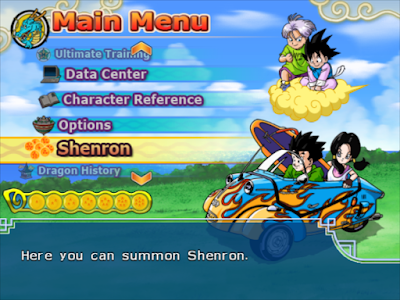
Aside from that the menus within the game have several visual cues to the Dragon Ball series such as character being chibi style similar to the tankōbon volumes of the manga with Goku riding on his nimbus cloud in the main menus and Puar turning himself into a menu for the options in Duel. Even the combat for Budokai has many DBZ fighting quintessentials. The mechanic Burst Zone has fast fighting similar to what's found within the show, you can also send opponents flying into environmental hazards, many of the characters' have their signature moves from the series, and ultimate moves are quite a sight to behold as you devastate your opponent. Even stuff like big explosions, destructive environments, and power auras are here for the course.

The loading screen even has something interesting going on with the radar showing the DBZ logo which you can toggle around though load times themselves are rather long taking up to 30 seconds even for well-working copies of the game.

Overall

Dragon Ball Z: Budokai is not the greatest fighting game out there... in fact, quite far from it even compared to many of the contemporary fighting games but as a game based on the insanely popular anime series it was great for the time. The combat, though limited, is fast-paced and fairly close to the action shown in the show, the art direction just screams "DRAGON BALL", it's easy to get into, and there's a whole lot to do. This game started what I'd like to call the "Golden Age of DBZ Gaming".

I give this game a 6.7 out of 10.